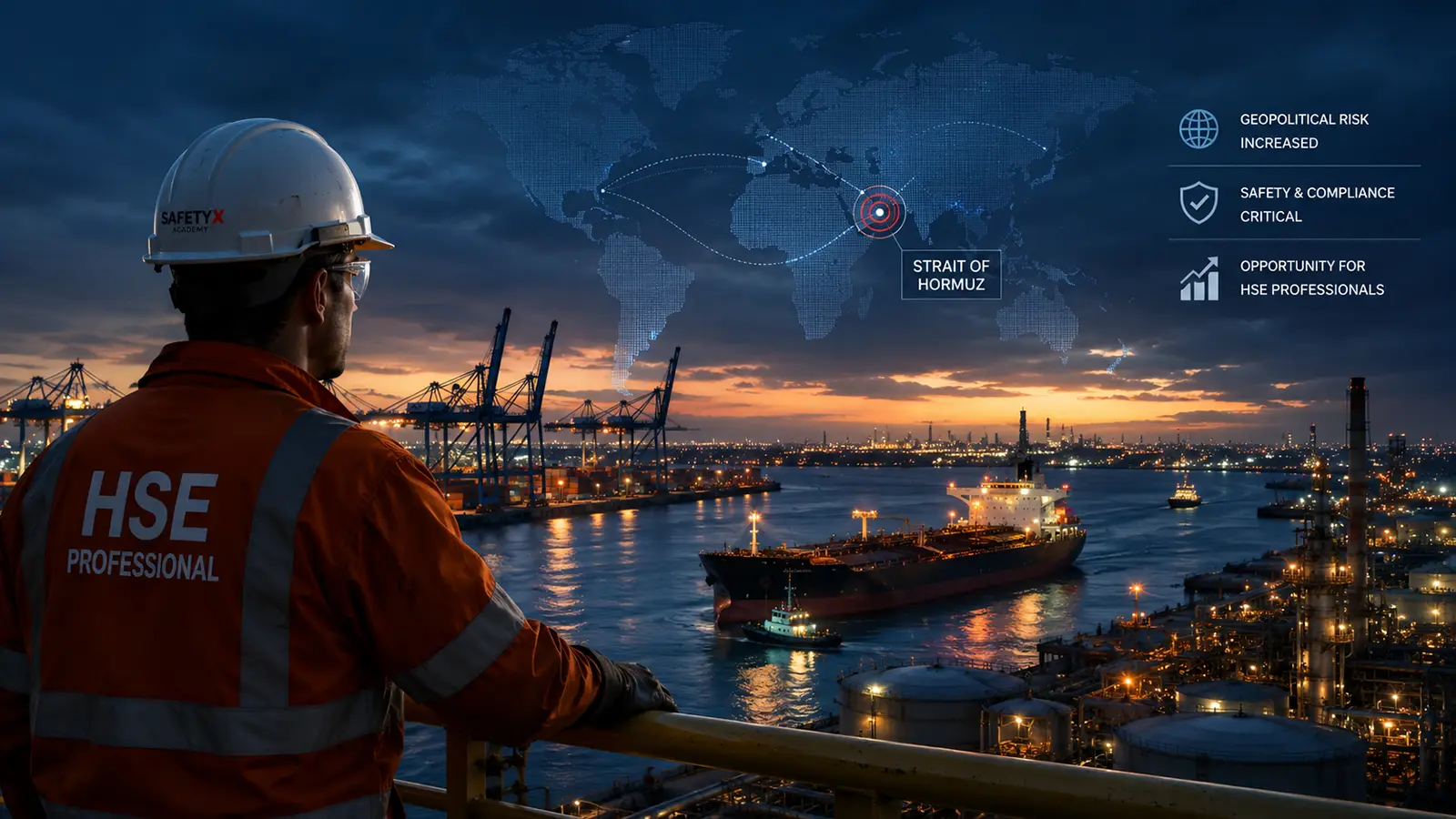
If you've followed the news even once a week over the past few months, you know it: the Middle East is restless. The Strait of Hormuz — that narrow stretch of water through which roughly a fifth of the world's oil normally flows — hasn't been its old self for months. Ships take detours, insurers charge premiums no one thought possible a year ago, and the oil price has sat above a hundred dollars a barrel for a while now.
To most people this sounds like news that happens far away. Something for analysts and oil traders, not for you and me. But if you work in a major port, on an offshore project, in a chemical plant or at a terminal — anywhere in the world — you feel it. Maybe not immediately in your weekly schedule, but certainly in the stricter audits, the sudden interest in your safety protocols, and the way clients suddenly want to know whether you really know what you're doing.
And that's where things get interesting for HSE professionals. Because precisely when the world becomes more uncertain, companies start thinking differently about safety. What used to be a cost becomes strategy. And those who are properly trained for it are now getting opportunities that didn't exist a year ago.
What's actually going on?
Briefly, because context helps. Tensions in the Middle East aren't new — the region has seen decades of escalation and calm — but lately the situation has stayed stubbornly unstable. Shipping through key routes has dropped sharply, some carriers avoid certain waters entirely, and the cost of what's called "war risk insurance" is four to six times higher than normal.
The Strait of Hormuz is the crucial pressure point. Less than forty kilometres wide at its narrowest, with a country on each side that isn't always friendly towards it. When that route falters, something in the world economy falters too. Oil gets more expensive, transport takes longer, and companies suddenly have to plan for scenarios they normally ignore.
For you as an HSE professional, that detail matters. Not because you need to write political analyses, but because it explains why your employer or client is suddenly asking different questions.
What do companies notice in practice?
Three things above all. First: cost. Fuel is more expensive, insurance is more expensive, and detours cost time and money. That means every mistake in an operation — an incident, an audit finding, a delay caused by poor risk management — is a bigger financial blow than before. A day of downtime used to cost money; now it costs a lot of money.
Second: compliance. International clients and insurers demand more. More documentation, stricter risk assessments, better emergency plans, sharper contractor management. Companies that used to get away with "we've always done it this way" find that answer no longer holds.
And third: attention from the top. Safety is suddenly a boardroom topic. Not as a cost, but as a reason a project does or doesn't go ahead, why an insurer will or won't sign, why a foreign client does or doesn't choose your company. That shifts how HSE roles are seen within organisations — and what they're worth.
What does this mean for your career?
Here's where it gets interesting. Because if safety becomes more strategic, the people who manage it become more strategic too. And you can see that in the market.
Demand for experienced HSE professionals is rising. Vacancies in oil and gas, offshore wind, at terminals, in chemicals and on international projects are getting harder to fill. Companies want people who don't just know one country's safety law by heart, but who can also talk to foreign contractors, understand international standards, and assess risk in work environments where the culture, language and regulation are different.
For contractors this means day rates are climbing. On high-risk projects you'll see rates between five hundred and fifteen hundred euros per day, sometimes more for specialist roles. And for those in permanent roles, it opens doors to positions that were previously only accessible to people with international experience or a foreign qualification.
But — and this is important — those opportunities don't simply go to the first person who shows up. Employers and clients are becoming more critical. They want to know you understand what you're talking about, even when the project isn't in Rotterdam but in Stavanger, Aberdeen, Dubai or Antwerp. And that's exactly where internationally recognised certificates make the difference.
Why NEBOSH IGC matters more right now
Practically speaking. NEBOSH stands for the National Examination Board in Occupational Safety and Health, a UK organisation that offers perhaps the best-known HSE qualifications worldwide. The International General Certificate, or IGC, is its international variant — not tied to one country or one set of laws, but built on principles that work everywhere.
What makes that extra relevant now? Three things.
One: recognition. NEBOSH is accepted in more than 180 countries. Not only in the UK where the standard comes from, but also in the Gulf region, Scandinavia, Southeast Asia, Africa and across Europe. For anyone who wants to work internationally — or even just for foreign clients in their own country — that's direct added value.
Two: content. NEBOSH doesn't teach you to memorise rules so much as the way of thinking you need to ask the right questions in any work environment. Risk assessment, hazard identification, management systems, contractor management, emergency response — all subjects that apply whether you're in a Rotterdam warehouse or on a rig off the Norwegian coast.
Three: signal. In practice, employers notice that NEBOSH on a CV says you didn't just pass a certificate — you were serious enough to pursue an internationally recognised qualification. In a market where international experience adds value, that difference counts.
A common question here: how does NEBOSH compare to local or national safety qualifications? Honest answer: they overlap a great deal, but they open different doors. A national qualification is firmly rooted in its local context — handy if you want to stay there and work with local legislation. NEBOSH IGC opens the wider world. Many professionals eventually earn both, in the order that fits their career.
What we see in Rotterdam
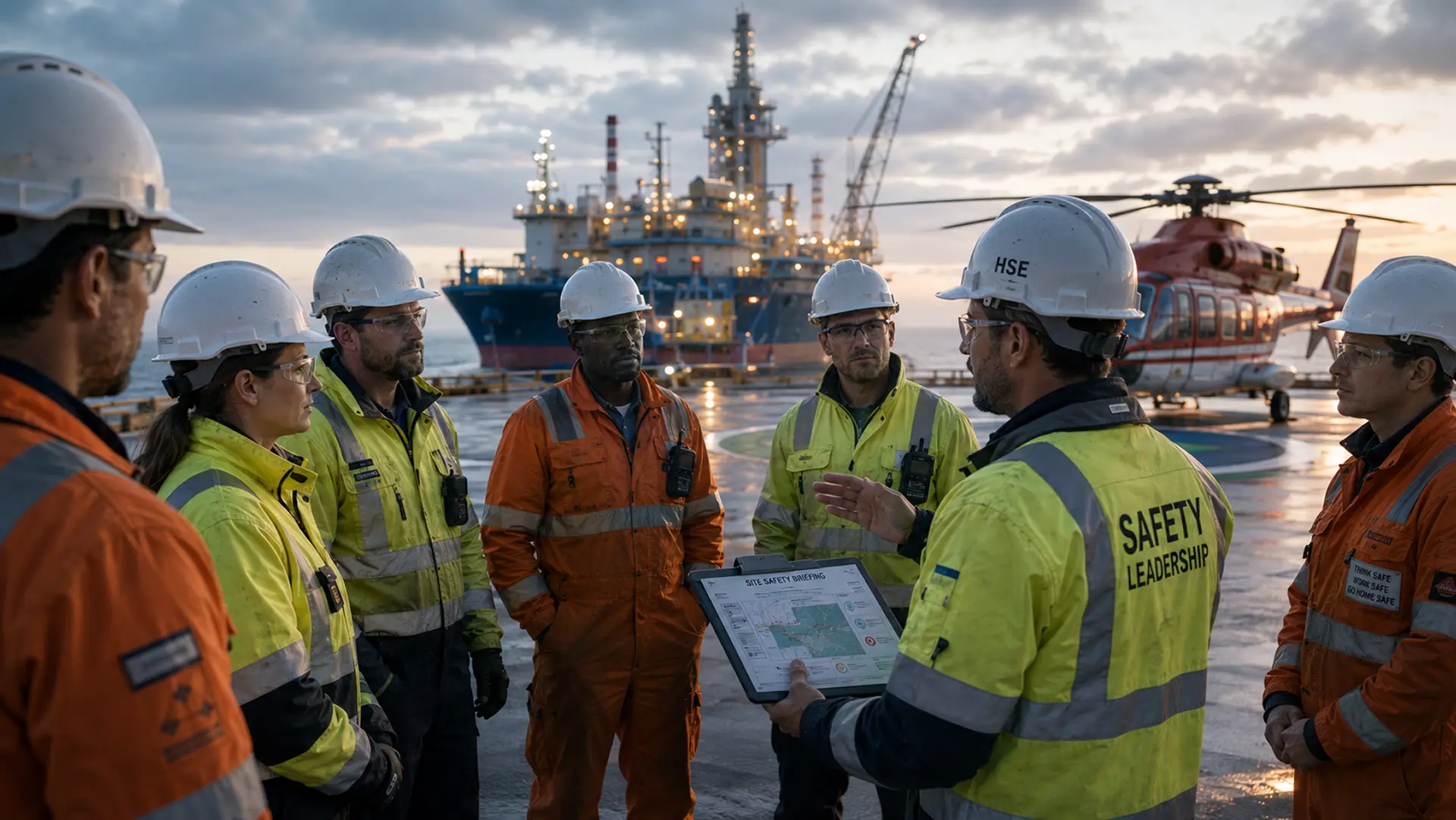
Our students are often people who've been in the field for years. Operators, supervisors, contractors who want to strengthen their position, people who want to make the move to international projects. What almost all of them say after the course is the same: it changes how they talk to clients. Not only because they know more, but because they now have a framework to place their experience in.
And yes, they also notice that employers respond differently. Recruiters who didn't call back before now do. Rates that used to require negotiation are accepted more quickly. A conversation with a foreign contractor goes differently when you use the same language and the same frameworks.
That's not magic. That's what happens when you invest in something your market values.
Finally
Unrest in the world rarely feels good. It makes people uncertain, makes companies cautious, and makes the future harder to plan. That's just how it is.
But for people who work in HSE — a profession that is, at its core, about thinking clearly in uncertain situations — that same unrest brings something else too. More attention to your work. More appreciation for expertise. More opportunities for those who position themselves the right way.
Whether that means you should invest in a NEBOSH IGC now depends on where you stand and where you want to go. It isn't the right moment or the right certificate for everyone. But if you've been thinking about it for a while, or if you notice the market around you changing and you want to move with it, this is a good moment to look into it seriously.
Our next NEBOSH International General Certificate starts in January 2027 in Rotterdam. Small groups of up to ten people, all-in price of €3,500 including the exam.
Enroll for the NEBOSH IGC in January 2027 →
Got questions — about the course itself, about how it compares to local qualifications, or whether it fits your situation? Feel free to send a message to info@safetyxacademy.nl. No sales pitch, just a conversation.