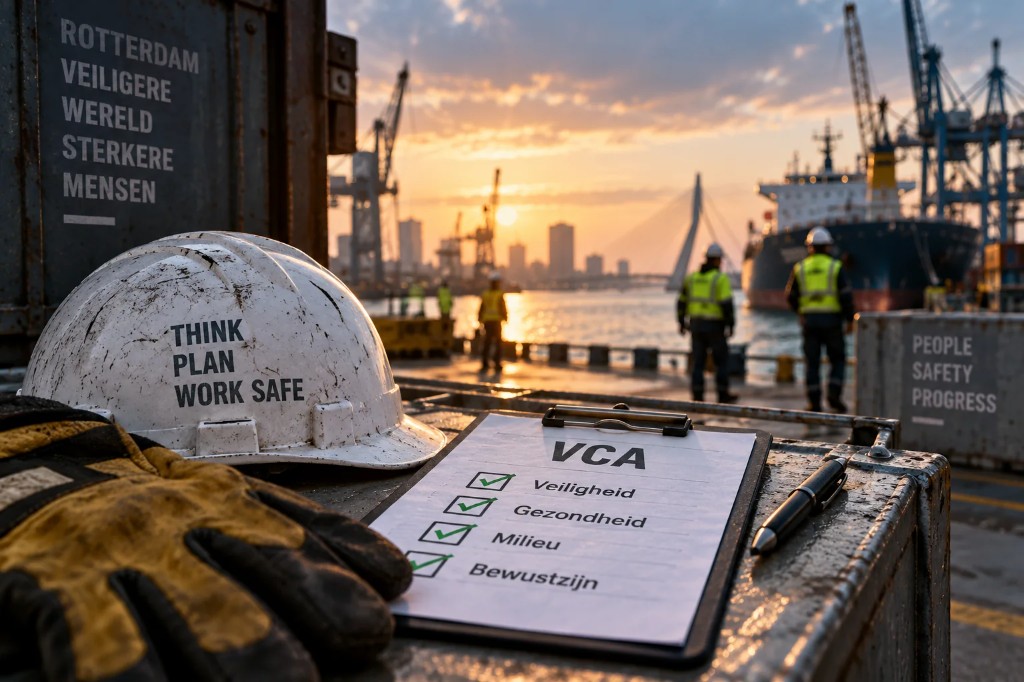
A crane lifts a heavy load over a work area. A forklift moves between workers. A maintenance crew starts work while other activities continue elsewhere on the site.
In ports, industry, construction and engineering, risks are part of the everyday working environment. That does not mean an incident is inevitable. It does mean that risks must be identified and controlled both before and during the work.
Three terms you will regularly encounter are RI&E, TRA and LMRA. All three deal with risk, but they are used at different levels and at different moments.
What are LMRA, TRA and RI&E?
RI&E, TRA and LMRA share the same overall purpose: safer work through identifying risks and taking appropriate control measures. The main difference is the level at which you assess risk and the moment when you do it.
RI&E: Risk Inventory and Evaluation
A RI&E (Risico-inventarisatie en -evaluatie) maps the occupational risks within an organisation. Examples include working with machinery, hazardous substances, physical strain, noise, workplace transport or working at height.
It therefore looks at the broader picture. Which risks are present within the organisation? How significant are those risks? And which measures are needed to control them?
A RI&E goes far beyond one individual task.
TRA: Task Risk Analysis
A TRA, or Task Risk Analysis, takes a closer look at a specific task or activity.
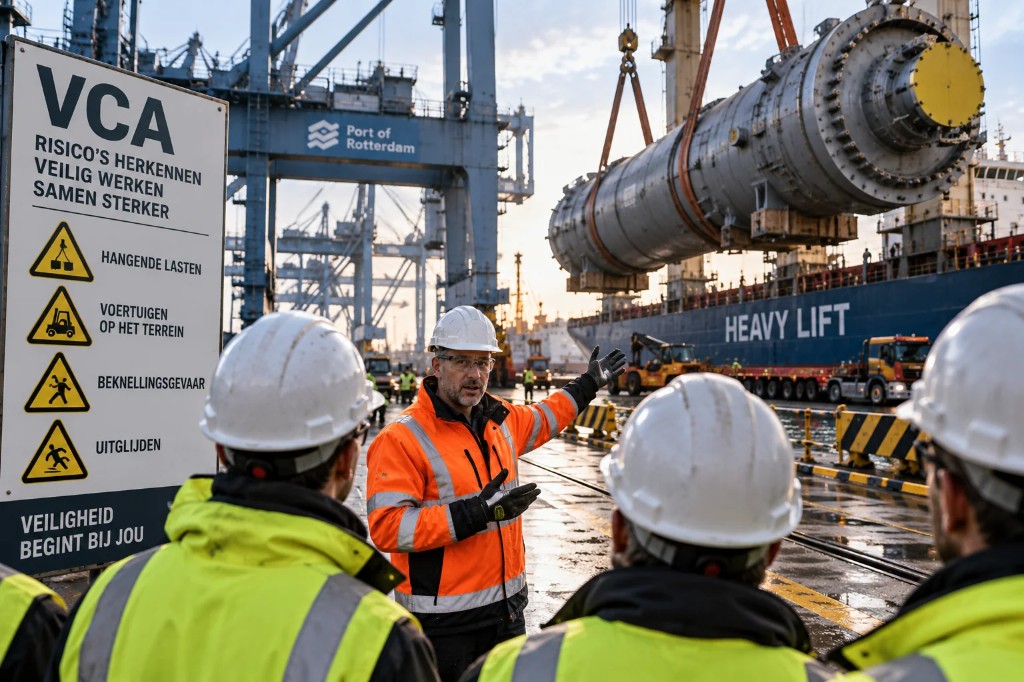
Suppose a heavy installation has to be moved by crane at an industrial site. Relevant factors may include the load, lifting equipment, the surrounding area, other ongoing work and the possible presence of people.
The central question is:
What could go wrong during this task, and which measures are needed to carry out the work safely?
LMRA: Last Minute Risk Analysis
The LMRA, or Last Minute Risk Analysis, takes place immediately before someone actually starts the work.
The plans may be correct and the risks may already have been assessed, but conditions at the workplace may have changed. The worker therefore takes one final, deliberate look at the actual situation.
The practical question is simple:
Can I carry out this work safely here and now?
If the answer is no, or if there is uncertainty, the work should not simply begin. It must first be clear how the risk will be controlled.
RI&E, TRA and LMRA: what is the difference?
You can think of the three instruments as different layers of risk management.
| Instrument | Level | When? | Key question |
|---|---|---|---|
| RI&E | Organisation | Periodically and when relevant changes occur | Which occupational risks do we have? |
| TRA | Task or activity | Before specific work | What could go wrong during this task? |
| LMRA | Actual workplace | Immediately before work and when relevant conditions change | Can I start safely here and now? |
They do not replace one another.
A RI&E does not mean that every risk associated with every specific high-risk task is automatically covered. And completing a TRA does not mean that a worker no longer needs to assess the actual conditions immediately before starting.
It is precisely the combination that ensures risks are considered at different levels.
Port example: lifting a heavy load
Consider a lifting operation in the Port of Rotterdam.
A large component has to be moved from the quay. Heavy equipment is positioned on site, workers are moving through the area and vehicles are using nearby traffic routes. The scale of the equipment alone makes it clear that a mistake could have serious consequences.
The organisation's RI&E may include general risks relating to lifting operations, workplace transport, vehicle collision hazards and working with heavy equipment.
A TRA may then be required for the specific lifting operation. This examines the task itself, the associated risks and the control measures that are needed.
Immediately before the work starts, the actual situation becomes decisive.
Is the work area still correctly cordoned off? Are there people present where they should not be? Is the route clear? Are conditions still the same as they were during the preparation? Has anything changed that means the task can no longer be carried out as planned?
This is exactly where the LMRA adds value.
What should you do when conditions change?
A common mistake is to assume that safe preparation automatically means the work will remain safe afterwards.
An industrial workplace is dynamic.
A vehicle may unexpectedly enter the work area. A barrier may have been moved. Weather conditions may change. Another crew may begin work nearby. Materials may be positioned differently from expected.
At that point, the original situation has changed.
Risk recognition is therefore not something you do once and then forget. Workers need to remain alert to changes that could affect their own work or the work of others.
When a relevant change occurs, it must be assessed again whether the work can continue safely. If that is unclear, simply carrying on is not the right response. The risk must first be discussed and controlled in accordance with the applicable arrangements and procedures.
Recognising risks is a skill
Safety is not just about rules, forms and procedures.
A worker also needs to be able to see what is happening.
Where could I be struck? Could something fall, move or tip over? Am I in the path of a vehicle or machine? Could a change in the surrounding area affect my work? Do I understand the instruction? And do I know what to do if the situation differs from the plan?
The ability to recognise risks becomes increasingly important as the working environment becomes more complex.
Good safety instruction therefore focuses not only on what someone must do, but also on why certain measures are necessary. When workers understand which hazard a measure is intended to control, safety becomes less of a list of rules and more of a way of looking at the work.
What do LMRA, TRA and RI&E have to do with VCA?
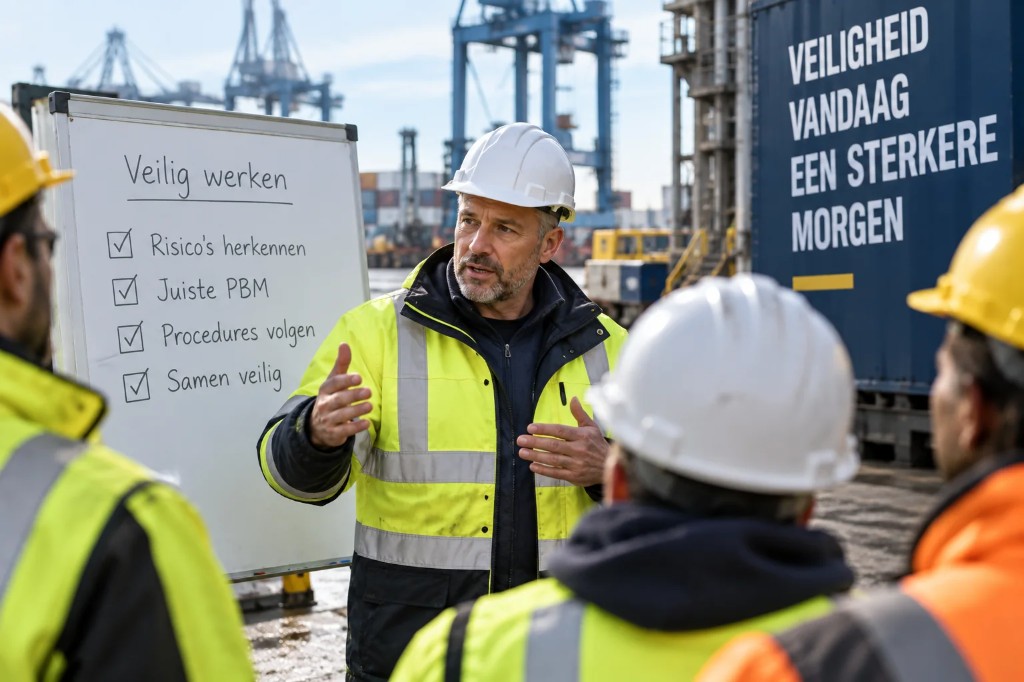
Within VCA, recognising hazards and carrying out work safely play an important role. People working at industrial sites need not only to know the rules, but also to understand how risks and control measures relate to each other in practice.
Terms such as LMRA and TRA are therefore commonly encountered in a VCA environment.
You will also encounter related terms such as VCA, B-VCA, VOL-VCA, SSVV, CDR, TRA and LMRA.
For a broader overview of the available VCA routes, see our VCA course in English in Rotterdam.
For employees and operational workers, B-VCA is generally the relevant route. VOL-VCA is intended for operational supervisors.
Frequently asked questions about LMRA, TRA and RI&E
Is an LMRA the same as a TRA?
No. A TRA analyses the risks of a specific task in advance and identifies the necessary control measures. An LMRA is a final check of the actual situation immediately before the work starts.
When do you carry out an LMRA?
An LMRA is carried out immediately before work begins. When relevant conditions change, it should be assessed again whether the work can still be carried out safely.
Who carries out an LMRA?
The LMRA is carried out by the person who is going to perform the work, in accordance with the organisation's safety arrangements and procedures.
Can an LMRA replace a RI&E or TRA?
No. The instruments serve different purposes. A RI&E considers occupational risks at organisational level, a TRA focuses on a specific task, and an LMRA focuses on the actual situation at the workplace.
Safer work starts with recognising risks
A procedure can be well prepared and a task may already have been analysed. Ultimately, people at the workplace still need to recognise when something is not right.
Especially in environments involving heavy equipment, vehicles, lifting operations and multiple activities taking place at the same time, a single change can alter the risk profile.
VCA provides a practical foundation for employees and supervisors who want to work safely and improve their ability to recognise workplace risks.
View SafetyXacademy's VCA training options
Last updated: 13 September 2026.